

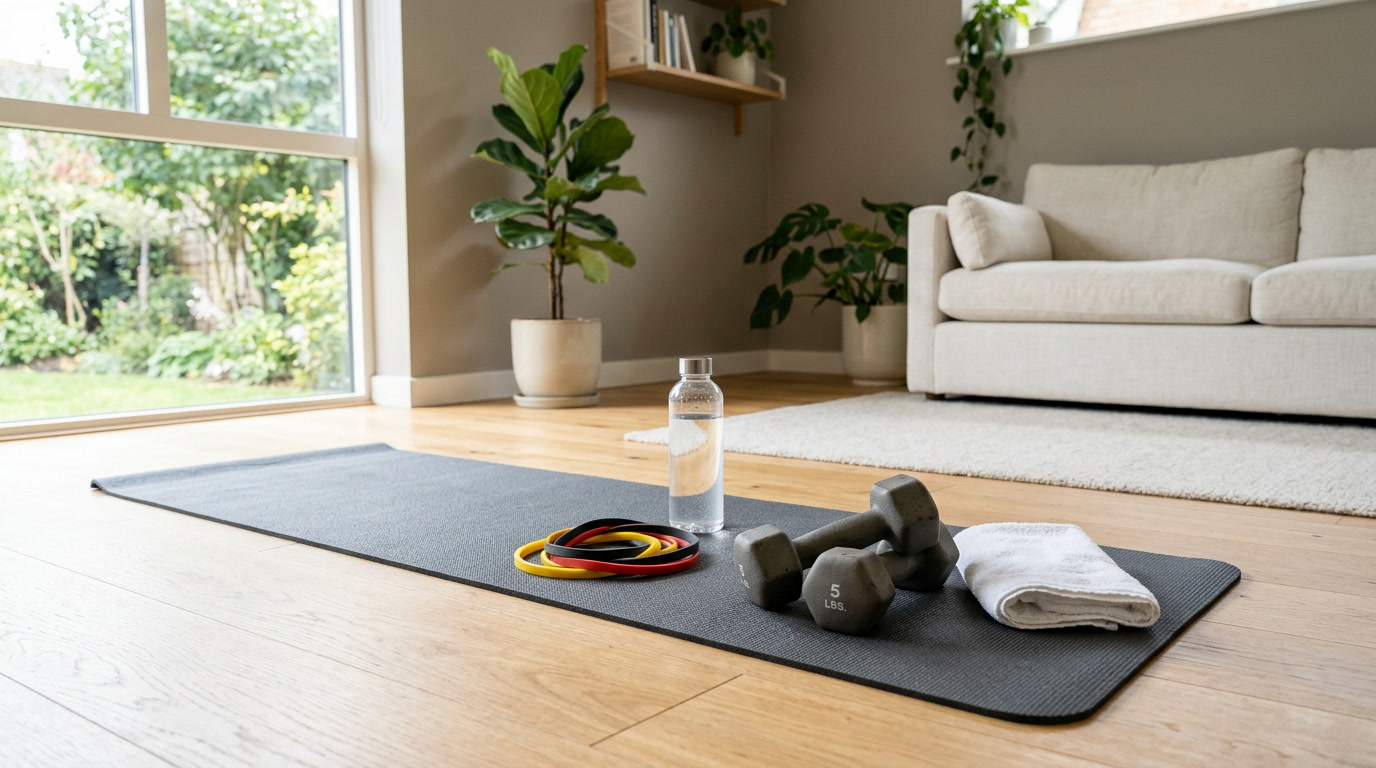
The most effective workout routines for burning fat at home combine full body strength training, steady cardio, short interval sessions, and more daily movement. Strength exercises help maintain muscle, while cardio increases energy use and improves heart fitness. Interval training can save time, but it is not required for successful fat loss.
Aim for at least 150 minutes of moderate aerobic activity each week and complete muscle strengthening exercises on at least two days. Start with shorter sessions if you are inactive. Gradually increase your workout time, effort, or number of repetitions as your fitness improves.
1. How Home Workouts Support Fat Loss
Your body stores unused energy as fat. Fat loss happens when your body uses more energy than it receives over time. Exercise supports this process by increasing the amount of energy you use.
However, exercise is only one part of weight management. Food choices, sleep, stress, medicine, hormones, age, and health conditions can also affect results.
The Centers for Disease Control and Prevention explains that physical activity combined with a suitable reduction in calorie intake creates the energy gap needed for weight loss. It also notes that regular activity is important for keeping weight off after it has been lost.
Home workouts can be effective because they remove common barriers. You do not need to drive to a gym, wait for equipment, or purchase an expensive membership. A small open space may be enough for walking, body weight exercises, resistance bands, or light dumbbells.
The main goal is not to find one perfect fat burning exercise. It is to create a routine that you can perform consistently and safely.
2. The Best Routine Combines Cardio and Strength
Cardio and strength training support fat loss in different ways.
Cardio activities raise your heart rate and increase energy use during the workout. Examples include brisk walking, marching, dancing, stair climbing, jumping rope, and cycling on a stationary bike.
Strength training works the major muscles of the legs, hips, back, abdomen, chest, shoulders, and arms. Examples include squats, lunges, wall push ups, floor push ups, glute bridges, rows, and overhead presses.
Strength training becomes especially important during weight loss because losing weight can also reduce muscle. Exercise can help preserve more lean tissue while body weight decreases.
Current guidance recommends that adults complete 150 to 300 minutes of moderate aerobic activity each week, along with muscle strengthening work on at least two days. More activity may provide additional benefits when it is increased safely.
For most people, a balanced week works better than doing only cardio or only strength exercises.
3. Full Body Strength Training Routine
A full body strength workout is one of the best home routines because it trains several large muscle groups within one session.
Complete the following routine two or three times each week.
Beginner Full Body Circuit
- Chair squats, 10 repetitions
- Wall push ups, 8 to 12 repetitions
- Glute bridges, 12 repetitions
- Standing rows with a resistance band, 10 repetitions
- Reverse lunges or supported split squats, 6 to 10 repetitions on each side
- Standing shoulder presses with light weights, 10 repetitions
- Bird dog exercise, 8 repetitions on each side
Rest briefly when needed. Complete one round when beginning. Build toward two or three rounds as the movements become easier.
Choose a version that allows you to control the movement and maintain good form. The final repetitions should feel challenging, but you should still be able to complete them without holding your breath or losing control.
The American College of Sports Medicine states that body weight exercises, resistance bands, and home strength routines can improve strength, muscle growth, and physical function. Expensive gym equipment is not required.
To make the routine harder, you can:
- Add more repetitions
- Add another round
- Use a stronger band
- Hold light dumbbells
- Slow the lowering part of each exercise
- Choose a more difficult exercise version
Progress gradually. A harder workout is only useful when you can recover and repeat it consistently.
4. Steady Cardio for Reliable Calorie Use
Steady cardio means moving at a fairly consistent effort for a set amount of time. This is one of the simplest ways to improve endurance and increase weekly activity.
Good home options include:
- Brisk walking indoors or outdoors
- Marching in place
- Low impact dance workouts
- Stair walking
- Step exercises
- Stationary cycling
- Shadow boxing
- Walking workout videos
A moderate effort should make your breathing faster while still allowing you to speak in short sentences. Begin with 15 to 20 minutes if 30 minutes feels difficult.
You can also divide your activity into smaller sessions. For example, three 10 minute walks can be easier to manage than one 30 minute workout.
A practical goal is 30 minutes on five days each week. This reaches the basic recommendation of 150 minutes. You can adjust the schedule around your job, family duties, and current fitness level.
Steady cardio is often easier to recover from than hard interval training. This makes it useful for beginners, older adults, or anyone who wants to exercise more frequently without making every session intense.
5. High Intensity Interval Training at Home
High intensity interval training, often called HIIT, alternates short periods of hard effort with easier recovery periods.
A simple session may involve 30 seconds of fast movement followed by 60 seconds of slow movement.
Beginner Interval Routine
Warm up for five minutes with easy marching and gentle movements.
Then complete:
- Fast marching or step jacks for 30 seconds
- Easy marching for 60 seconds
- Body weight squats for 30 seconds
- Easy walking for 60 seconds
- Fast shadow boxing for 30 seconds
- Easy movement for 60 seconds
Repeat the sequence three or four times. Finish with several minutes of easy walking.
People with more experience may use mountain climbers, squat jumps, jumping jacks, burpees, or fast stair climbing. High impact exercises are not required. Fast low impact movement can also raise your heart rate.
Research shows that interval training and moderate continuous cardio can both reduce body fat. Recent reviews have not consistently found HIIT to be better than regular cardio when total exercise work is similar. Its main advantage is that it can provide a demanding workout in less time.
HIIT should not make up every workout. Hard sessions may be difficult to recover from, especially when you are new to exercise. One or two interval sessions per week can be enough for many home routines.
6. Low Impact Fat Burning Workout
You do not need to jump, run, or perform burpees to complete an effective workout.
Low impact exercise keeps at least one foot on the floor and places less stress on the joints. It may be more suitable for beginners, people with larger bodies, older adults, or anyone managing knee, hip, or back discomfort.
Twenty Minute Low Impact Circuit
Complete each movement for 40 seconds. Rest or march slowly for 20 seconds.
- Marching in place
- Chair squats
- Side steps with arm reaches
- Wall push ups
- Standing knee lifts
- Glute bridges
- Step touches
- Resistance band rows
- Supported reverse lunges
- Slow mountain climbers against a wall
Complete the full list twice.
Make the workout easier by reducing the movement range, slowing the pace, or using a chair for support. Make it harder by increasing your pace, holding light weights, or adding a third round.
Low impact does not mean low effort. Large arm movements, faster marching, and repeated lower body exercises can still create a challenging session.
7. Body Weight Cardio Circuit
A body weight circuit combines strength and cardio exercises with limited rest. This keeps the heart rate raised while training several muscle groups.
Thirty Minute Home Circuit
Warm up for five minutes.
Complete each exercise for 40 seconds, followed by 20 seconds of rest.
- Squats
- Incline push ups against a table or counter
- Fast marching
- Alternating reverse lunges
- Mountain climbers against a chair
- Glute bridges
- Shadow boxing
- Step ups on a stable step
- Plank from the knees or toes
- Side steps with arm swings
Rest for one or two minutes after completing the list. Repeat it two times.
Focus on steady movement rather than trying to move as quickly as possible. Poor form can reduce the value of the exercise and raise the chance of pain.
Beginners can work for 20 seconds and rest for 40 seconds. More experienced people can increase the work period or add resistance.
8. Building a Home Routine in Charlotte, North Carolina
Your weekly plan should match your current fitness, schedule, and recovery needs.
A simple beginner week may look like this:
Monday
Twenty minutes of full body strength training
Tuesday
Twenty to thirty minutes of brisk walking or low impact cardio
Wednesday
Rest or complete gentle mobility exercises
Thursday
Twenty minutes of full body strength training
Friday
Fifteen to twenty minutes of interval training
Saturday
Thirty to forty minutes of walking, dancing, or cycling
Sunday
Rest or complete an easy walk
This schedule includes strength, steady cardio, intervals, and recovery. It also gives you room to move sessions when work or family duties change.
Consistency matters more than following the schedule perfectly. Missing one day does not ruin your progress. Continue with the next planned session instead of trying to punish yourself with an extra hard workout.
9. How to Make Home Workouts More Effective
A workout must gradually challenge your body if you want your fitness to continue improving.
This process is called progression. You can progress without buying more equipment.
Try changing one factor at a time:
- Increase a 15 minute workout to 20 minutes
- Add two repetitions to each strength exercise
- Complete one extra circuit
- Reduce rest periods slightly
- Use a stronger resistance band
- Walk or march at a faster pace
- Improve your exercise range of motion
- Perform a more difficult movement version
Do not increase everything during the same week. Small changes are easier to recover from and make it easier to notice what caused soreness or fatigue.
Track a few basic details after each workout:
- Exercise time
- Number of rounds
- Resistance used
- Energy level
- Difficulty
- Any pain or discomfort
You do not need to record every calorie. Exercise watches and machines provide estimates, not exact measurements. Use them to observe general patterns rather than treating every number as perfect.
10. Common Fat Loss Workout Mistakes
One common mistake is choosing workouts that are too difficult. Extreme soreness may cause you to skip several days, which can reduce weekly activity.
Another mistake is only doing abdominal exercises. Sit ups and planks can strengthen your middle, but they do not guarantee that fat will disappear from that exact area. One controlled study found that six weeks of abdominal exercises improved muscular endurance but did not significantly reduce abdominal fat.
Other common mistakes include:
- Doing hard intervals every day
- Ignoring strength training
- Changing routines every few days
- Expecting fast body changes
- Exercising without enough sleep
- Eating more because a workout felt difficult
- Copying advanced exercise videos too soon
- Continuing through sharp pain
- Comparing your progress with edited online images
- Treating sweating as proof of fat loss
Sweat helps regulate body temperature. A very sweaty workout is not automatically more effective than a steady strength or walking session.
The most useful plan is one that improves your fitness while allowing you to return for the next workout.
11. Safety and Recovery Tips
Begin each session with several minutes of easy movement. March in place, roll your shoulders, move your arms, and practice easier versions of the planned exercises.
Finish with slower movement so your breathing and heart rate can gradually settle.
Drink water throughout the day. You may need more fluids during long workouts, hot weather, or heavy sweating.
Stop exercising and seek medical attention if you develop chest pain, fainting, severe shortness of breath, confusion, or sudden weakness.
Speak with a health care professional before beginning a demanding routine if you have heart disease, uncontrolled blood pressure, serious joint problems, diabetes complications, recent surgery, pregnancy concerns, or symptoms that appear during activity.
Government exercise guidance advises inactive adults to begin with small amounts and gradually increase frequency, time, and effort. People with chronic conditions may also need help choosing suitable activities.
Recovery supports progress. Include easier days, get enough sleep, and avoid training the same sore muscles hard every day.
12. Frequently Asked Questions
What home workout burns the most fat?
There is no single workout that burns the most fat for everyone. A combination of strength training, steady cardio, interval work, and regular daily movement is usually more practical than relying on one exercise.
Is 20 minutes of home exercise enough?
Yes. A focused 20 minute session can improve fitness and add to your weekly activity total. Beginners can start with shorter sessions and gradually build toward recommended weekly activity levels.
Should I do cardio or strength training first?
Do the activity that matters most for your goal first, when your energy is highest. If strength and muscle maintenance are priorities, complete strength work first. You can also perform them on separate days.
How many days should I exercise to lose fat?
Many people do well with activity on four to six days each week, including at least two strength sessions. Your total weekly time and consistency matter more than exercising every day.
Can I lose belly fat with home workouts?
Home exercise can help reduce total body fat, which may include abdominal fat. You cannot fully control where your body loses fat first. Combine regular activity with suitable eating habits and enough recovery.
Conclusion
The most effective home routine combines full body strength work, moderate cardio, and occasional interval sessions. Strength training supports muscle, cardio increases weekly energy use, and intervals provide a faster option when time is limited.
Start with manageable workouts and increase the challenge gradually. You do not need expensive equipment, difficult jumps, or long daily sessions. You need a balanced plan that you can repeat from week to week.
For more practical fitness and healthy living guidance from Books_WD, choose one beginner routine from this guide and schedule your first session today.
